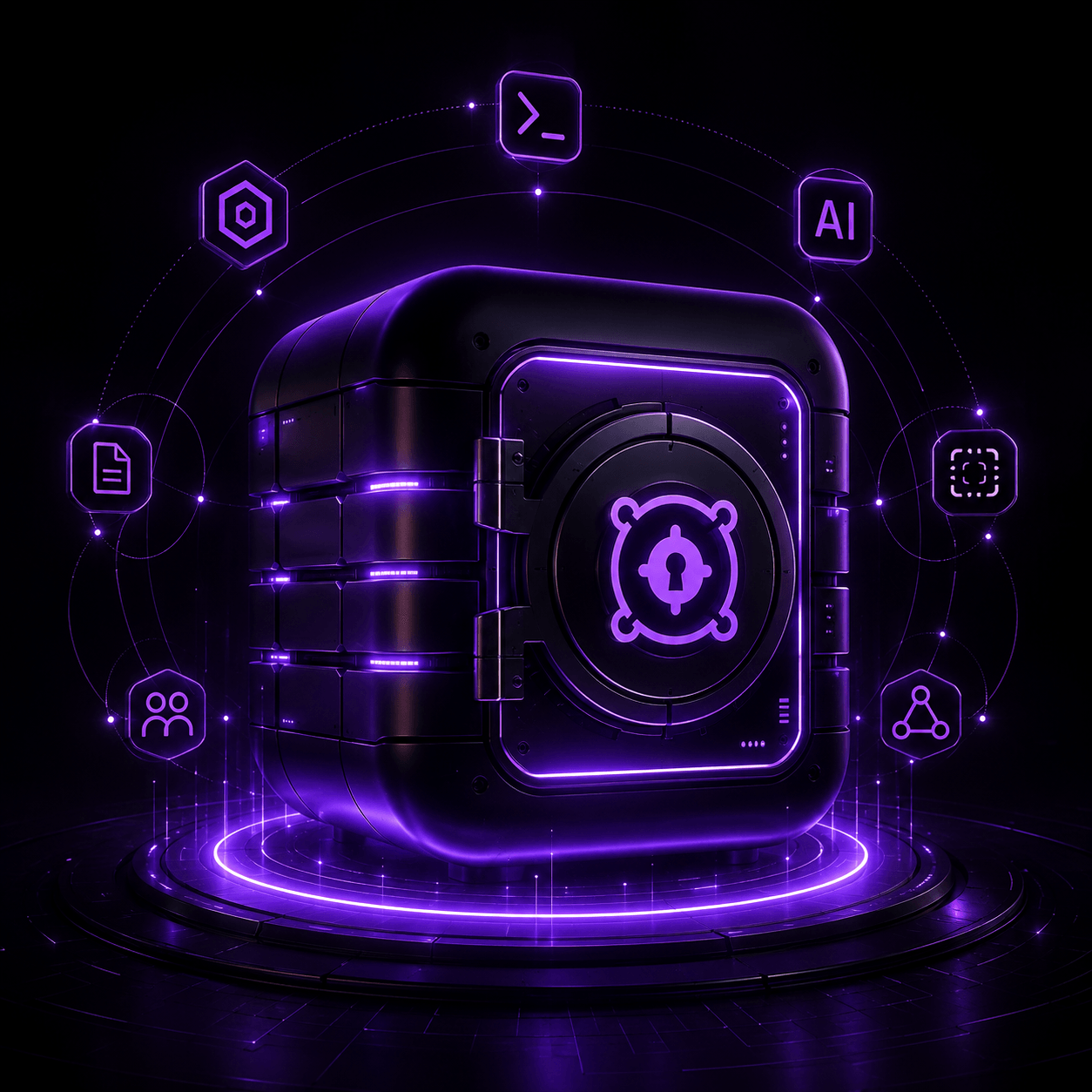
Open-source local-first memory infrastructure for AI agents, combining a desktop console, CLI, MCP server, durable handoffs, smart recall, and project graph intelligence.
- Role
- Product Designer & Full-Stack Developer
- Client
- Personal / Open Source
- Year
- 2026
The Vault is an open-source, local-first memory operating system for AI-assisted work. It stores high-signal decisions, plans, handoffs, implementation summaries, task results, project relationships, and next steps outside any single model or chat product. Agents retrieve compact ranked recall packs instead of loading the entire memory store.
A shared TypeScript core powers the CLI, FastMCP server, and Electron desktop console. Windows releases bundle the Vault memory runtime so Codex, Claude Desktop, and Claude Code can connect without keeping the source repository installed.
Optional Graphify integration adds project-graph queries, paths, neighbors, and impact analysis. Optional Vault Collab adds provider-neutral sessions, roles, handoff inboxes, discussions, policy packs, and explicit approval-gated agent launches. Local storage, inspectable records, reversible lifecycle states, and reviewable cleanup keep the operator in control.
The challenge
The first challenge was turning a growing local memory store into useful agent context instead of another data dump. The recall engine combines project matching, typed records, promoted decisions, recency, keywords, tags, pruning, and explicit open loops to return compact packs sized for the active task.
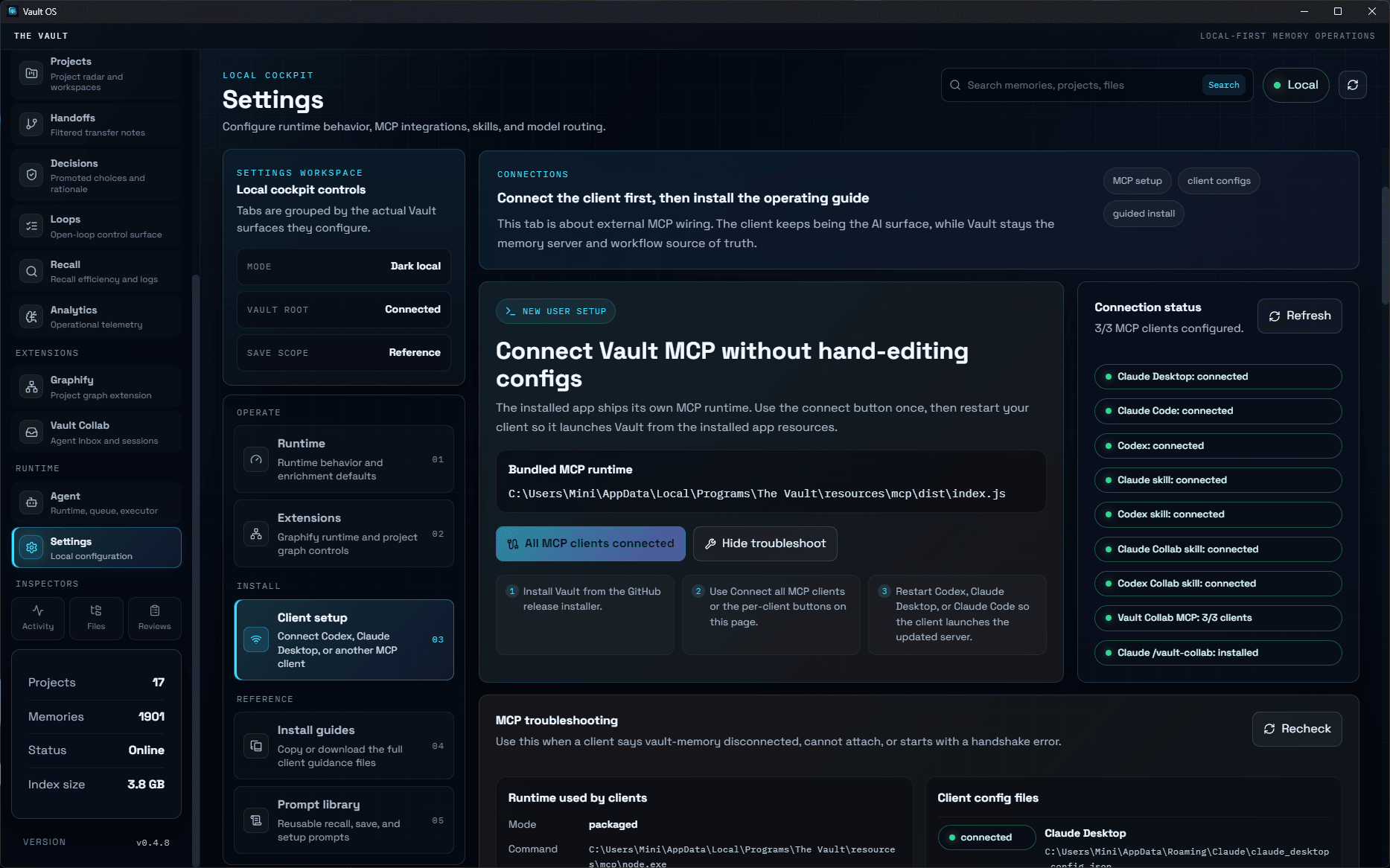
The second challenge was supporting multiple clients without making setup fragile. The shared core keeps CLI, MCP, and desktop behavior aligned, while the Windows bundle carries its own memory runtime and the setup flow backs up client configuration before touching only Vault-owned entries.
Optional systems such as Graphify and Vault Collab also had to add power without making the base memory product brittle. They use separate extension boundaries, explicit availability checks, fallback behavior, pull-based coordination, and user approval for external agent launches.
Structured Project Memory
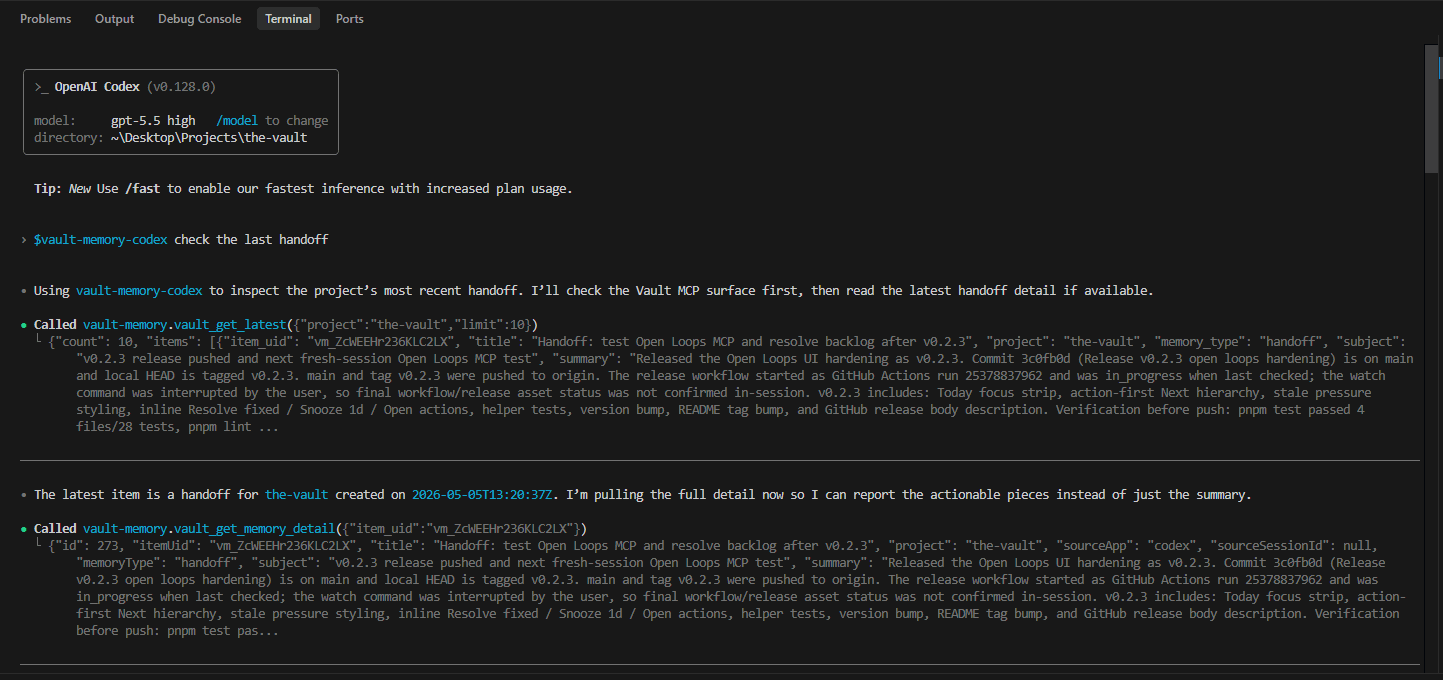
Typed records capture decisions, plans, sessions, handoffs, summaries, artifacts, references, related files, priority, lifecycle state, tags, keywords, and explicit next steps per project.
Project memory survives models, clients, and sessions
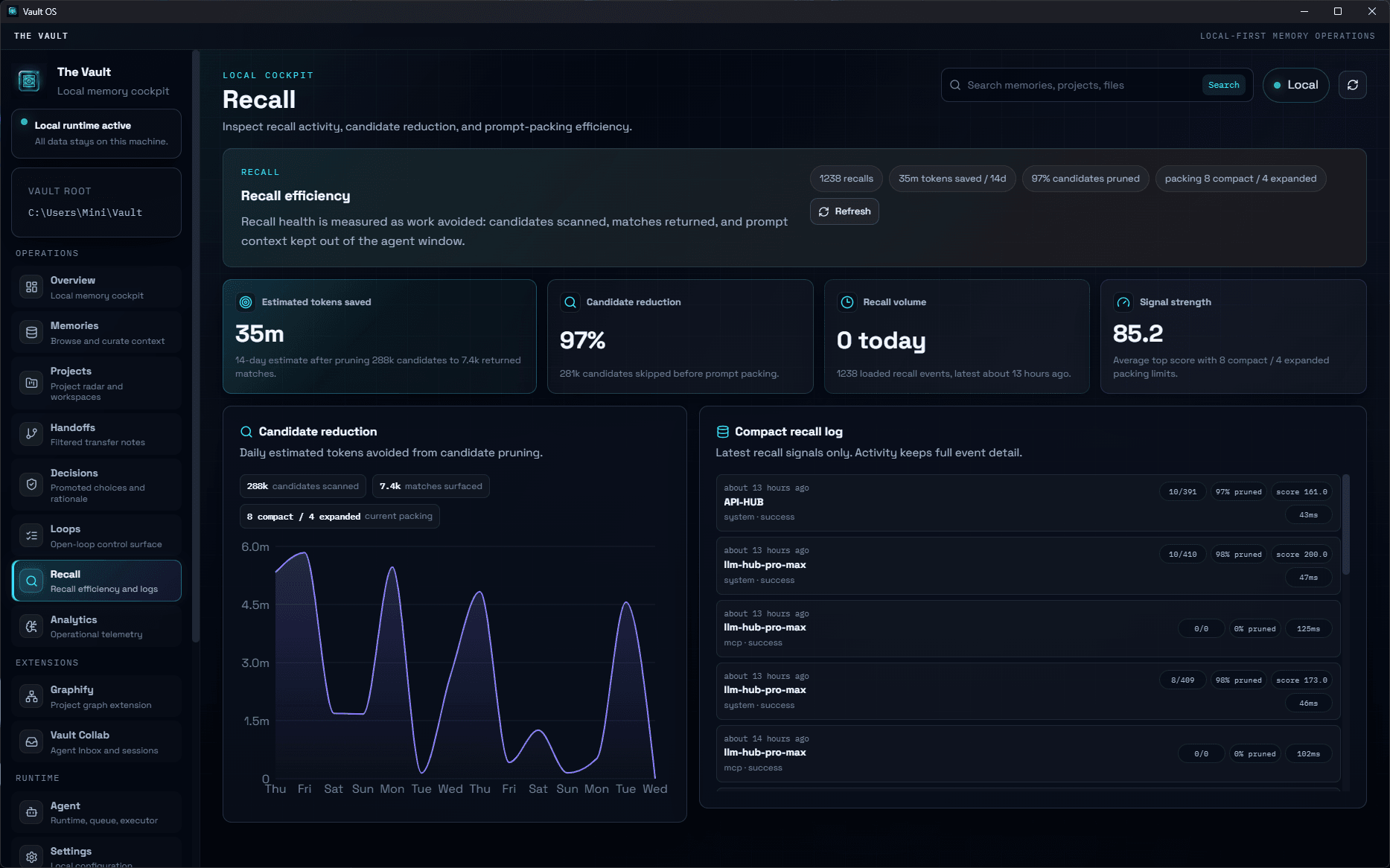
Smart Recall & Open Loops
Candidate search, ranking, pruning, promoted decisions, and pressure-ranked open loops produce compact context packs while keeping unfinished work visible and resolvable.
Relevant context without dumping the full store
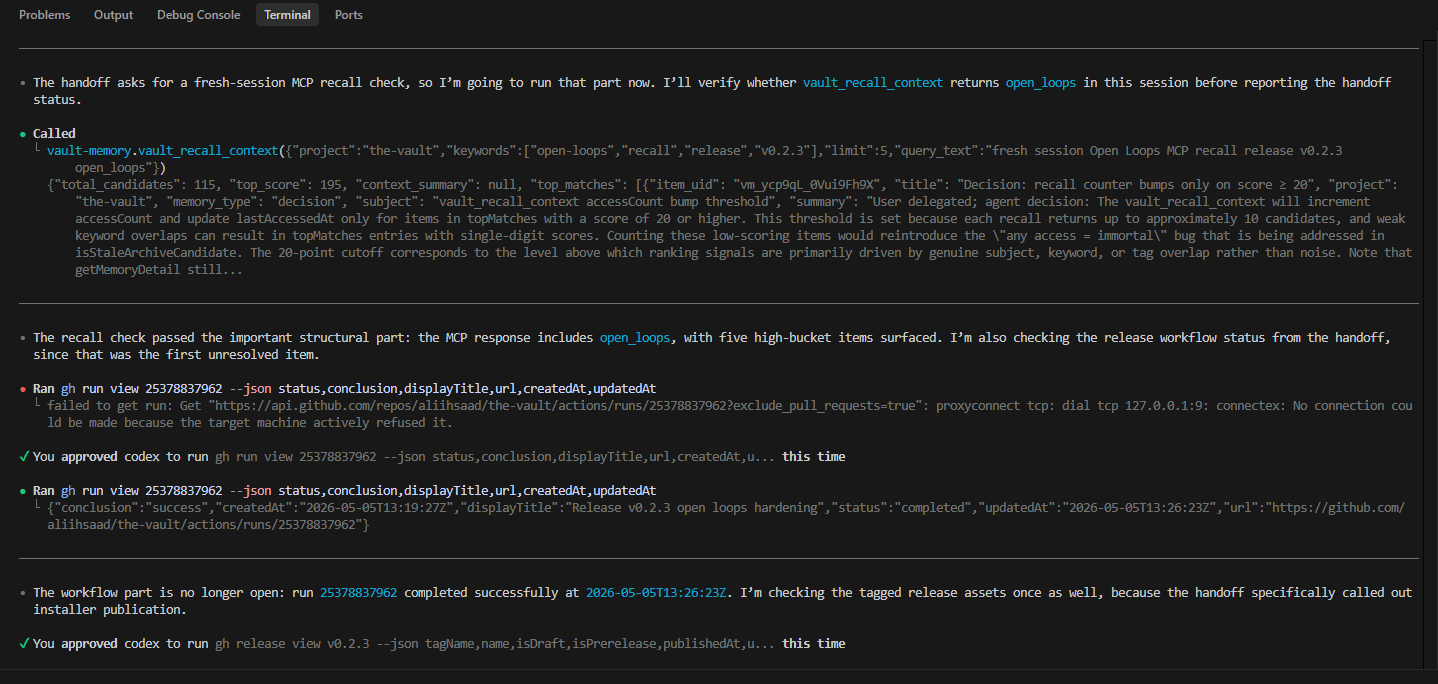
Cross-Agent MCP Continuity
The vault-memory MCP server gives Codex, Claude Desktop, Claude Code, and other MCP clients one shared interface for recall, saves, tasks, project hygiene, and handoffs.
One local memory layer for multiple agent clients
More details (4)
Electron Operator Console
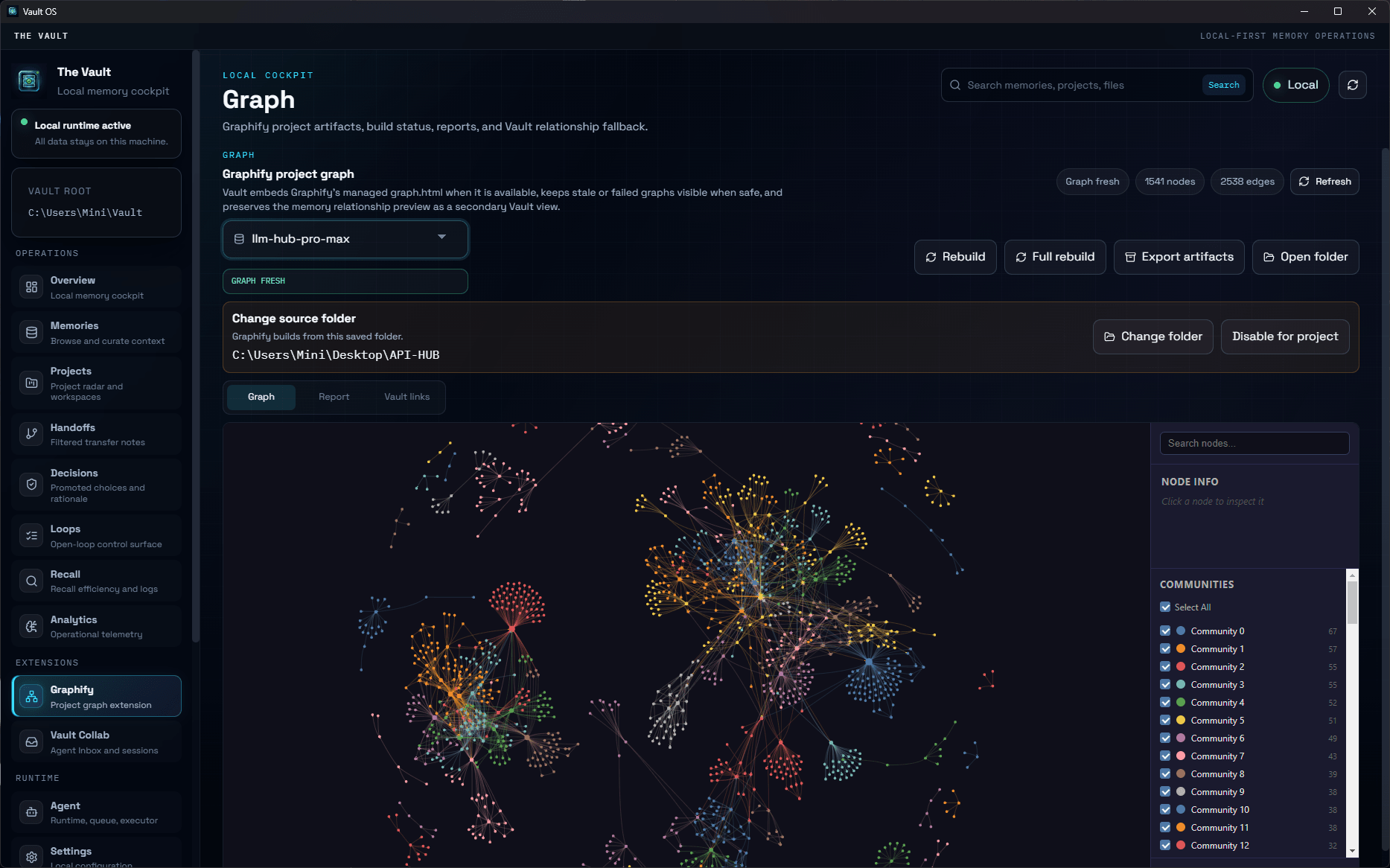
The desktop app surfaces projects, memories, handoffs, decisions, loops, recall analytics, tasks, Graphify, collaboration, lifecycle reviews, activity logs, and client setup in one operational interface.
Inspect, operate, and curate memory visually
Graphify Code Intelligence
An optional managed project graph lets agents query structural context, neighbors, paths, central nodes, likely files, tests, and impact before reading large parts of a repository.
Graph-aware recall and change impact analysis
Vault Collab Operations
The optional collaboration layer provides provider-neutral sessions, roles, handoff inboxes, append-only discussions, leases, events, policy packs, and explicit user approval before launching new workers.
Pull-based coordination with approval-gated launches
Local-First Trust Controls
Memory files and SQLite state stay on the user's machine by default. Recall exposes compact packs, client setup backs up configs, and destructive cleanup passes through reversible lifecycle states and review.
Local, inspectable, reversible, and reviewable
The Vault delivers one local operational memory layer across desktop, CLI, and MCP clients. A coding agent can save a structured handoff in one session, another client can recall the same decisions and next steps later, and the operator can inspect or curate the record from the desktop console.
The project also extends continuity beyond text memory: Graphify narrows repository exploration with structural context, while Vault Collab coordinates live sessions and handoffs without silently spawning workers. Local storage and reviewable lifecycle controls preserve ownership of both data and automation.
- Interfaces
- Electron desktop, CLI, and MCP server
- Storage Model
- Local-first and inspectable
- License
- MIT open source